Türkçe  
   
   POWER RESISTORS
Neutral Grounding Resistors
Generator Neutral Grounding &
Leads Cubicles
Inverter Braking Resistors
Motor Starting &
Control Resistors
Cubicle Heaters
Harmonic Filter Resistors
Current Limiting Resistors
RC Filters
   REACTORS
Current Limiting Reactors
Neutral Grounding Reactors
Shunt Reactors
Harmonic Filtering Reactors
Motor Starting Reactors
Electric Arc Furnace Reactors
Smoothing Reactors
Line and Load Reactors
Test Laboratory Reactors
   TESTING SYSTEMS
Turn-key Short Circuit
Laboratories
High Current Injection Test Sets
R - L - C Load Banks


HOME
ABOUT US
CONTACT US
CAREERS
SITE MAP
   
   
INVERTER BRAKING RESISTORS
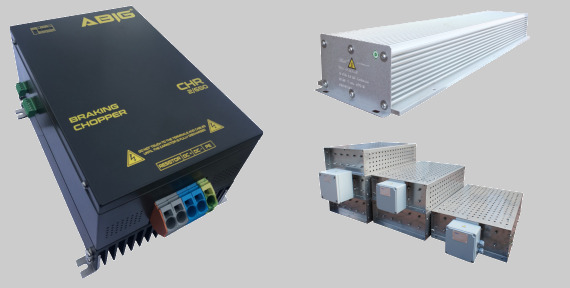
Inverter braking resistors are used to stop ac and dc motors with inverter control. Design of Inverter Braking Resistors depend on recommended braking periods or specific applications.
 
 
inverter7
 
inverter   inverter
 

  TECHNICAL PROPERTIES :

  - CONTINUOUS POWER (W)

: 50.....10000

For 120 seconds of motor's duty cycle :
- POWER FOR 6 SECONDS
- POWER FOR 12 SECONDS
- POWER FOR 60 SECONDS
- SHORT TIME POWER (kW)

: 20xCONTINUOUS POWER
: 10xCONTINUOUS POWER
: 2xCONTINUOUS POWER
: 1...200 (ED=%5)

  - VOLTAGE

: 1.....1000 V

  - INSULATION LEVEL (kV)

: 3 for 60 sec.

  - RESISTANCE VALUE (ohm)

: On Demand

  - COOLING

: Natural

  - PROTECTION DEGREE

: IP 20


Tips for Easy Inverter Braking Resistor Selection for Electricians

Electric motors in certain cases run as a generator by the machine that it is operating and feeds the electric network. If the motor is required to stop or slow down to nominal speed in such cases, a resistor with suitable ohmic and watt ratings is connected to inverter braking terminals in order to convert the energy generated by motor to dc current and convert it into heat through inverter braking resistor. Required power of a braking resistor (dynamic braking) in order to brake a motor that rotates at maximum speed and maximum load must be equal to the power of the motor. However, as the braking time is generally around a few seconds, a resistor power rating that is smaller than motor's rated power can be over loaded for a short time in order to provide an economical way of braking.

Warning 1 : Ohmic value of resistors for braking purposes can not be less than stated inverter braking resistor manufacturer catalog values. Otherwise, inverter and resistor can be damaged. If the ohmic value chosen is larger than inverter catalog's recommened value, braking time gets longer. Braking time is determined by the weight and speed of rotating parts.

Warning 2 : If braking time is unknown, as a safety tolerance , the resistor watt rating should be chosen the same as the motor's power rating.

Example 1 : Suppose that an electric motor with a power rating of 100 kW, is lifting a load for 60 seconds and descending the load for 60 seconds with dynamic braking. The operation factor (ED%) for this system will be ED% = 60/(60+60) = 50 % . As a result of this fact, this braking resistor will operate for 60 seconds and cool down for 60 seconds within the operation cycle of 120 seconds of the crane. As a result of this fact, a braking resistor that will brake a 100 kW motor for 60 seconds must withstand operating  0,50 x 100 = 50 kW continuously  and 100 kW for 60 seconds.

Example 2 : If  a 100 kW electric motor is running 10 seconds and dynamic braking is being applied for 80 seconds within a time frame of 90 seconds, as the braking time is longer than 60 seconds, it is considered as continuous braking and an inverter braking resistor which can withstand 100 kW continuously is strongly recommended.

Example 3 : Suppose a 100 kW electric motor is rotating a fan and after the frequency of motor becomes zero, the fan stops with a braking resistor at 6 seconds. If the motor will start running after Tr = 54 seconds, a smaller wattage rating for this application can be selected.
Overload time (Tbr) = 6 seconds
Braking Resistor Power at Overload (Pbr) =  Pmotor x Tbr / (Tbr + Tc) = 100 x 6 / (6+54) = 10 kW . So a resistor with a power rating of 10 kW is enough for his application.
Over Load Multiplier of this resistor (OLM) = (6+54)/6 = 10 , So an 10 kW resistor must withstand the power of 10 x 10 = 100 kW for 6 seconds.

Relationship between Over Load Multiplier / Cooling time / Over Load Time can be seen in the following graph.

 
inverter
 
HOME  .  ABOUT US  .  CONTACT US  .  CAREERS  .  SITE MAP